


Fractal Spring 2026 courses are live. Applications are due 3/25!
I didn't know my posture was costing me anything until I lay down on a floor in Brooklyn with a book under my head. At that time, I was working as a consultant with a client who made us work in an almost windowless room with only high-top chairs. My team jokingly called it “the cave”.
So where did this remedy come from?
Fractal is a community university in New York, built by a group of friends who wanted to learn things together. In two years it’s become the place where I’ve learned more about how I actually live than anywhere else. Modern work is very good at teaching you to ignore your body, your instincts, and your taste. Fractal taught me the opposite.
This week, I wanted to synthesize what I’ve learned from the classes that have impacted me the most.
Alexander Technique
It started with something I hadn’t thought about in years: how I was holding myself.
I took Alexander Technique with Ulysses. To be honest, if you want a proper understanding of what AT is, I recommend reading Ulysses’s incredible book, Juggling In the Unknown. In summary, AT is a somatic practice that teaches you to notice and release habitual tension patterns in your body, particularly in the relationship between your head, neck, and spine.
For me, the moment that encoded AT in my body was at the end of our first class. Ulysses had taken the time to give us some personalized feedback on our posture (I tended to, and still tend to, arch my lower back), we had gone through some exercises of sitting up and down in chairs, and then ended with lying down, head against a book on the floor, while he guided us through the typical “directions” of AT.
“Neck is free, head is forward and up, the spine lengthens and widens”. The combination of these directions, subtly transmitted to a body somehow between conscious and unconscious, as well as the natural gravity of the spine spilling from the book, resulted in standing up with a posture that felt more natural than I had experienced in months, probably even years.
But what I noticed far more than the immediate body was that my sense of perception felt so much sharper, settled. Ulysses pointed it out. It was subtle but very powerful. “See how you feel now?”, he said, “this is how you could feel all the time, if you let your body be.”
As I continued to attend the class, I started to notice it’s patterns showed up in the real world. I was suddenly aware of how much my shoulders would tense up when I was writing a document I was stressed about, or how I would clench during a meeting when my name was called. When I noticed and consciously reversed them, my stress levels would follow accordingly.
This relationship between structure and energy, of my body being the conduit for my internal alignment and subtle joy, changed my life.
Twitter Sprint
The second was my voice. More precisely, my willingness to use it.
I took this class with Priya over the summer of 2024. I’ll admit I was hesitant, as I’ve never really used social media, and the thought of posting online (still) makes me squeamish. But my friend had promised it was fun, so I went.
What I loved about this was that it made me confront my fear of being “online” head on. The premise was that Twitter (now X, but also applicable to Substack notes), is a conduit for real-world spontaneity, but you need to give it something to work with. Twitter was a foreign land to me, but what Priya did was essentially just give us a menu of options that we could take to use it our way.
Wether having a specific format to lean on (I started by posting 100 mini itineraries of things to do in new york), writing threads on what you read, or just challenging yourself to articulate an observation, the class was really a container and a support system to put yourself out there.
Through Substack I’ve met collaborators, started conversations, found people. But the real shift was simpler, I started to believe my thoughts were worth sharing. And most importantly, I stopped making it a whole thing.
Transform Your Space: An Interior Design Sprint for NYC Renters
The third was form and function: that a room designed with intention makes you feel like a different person in it.
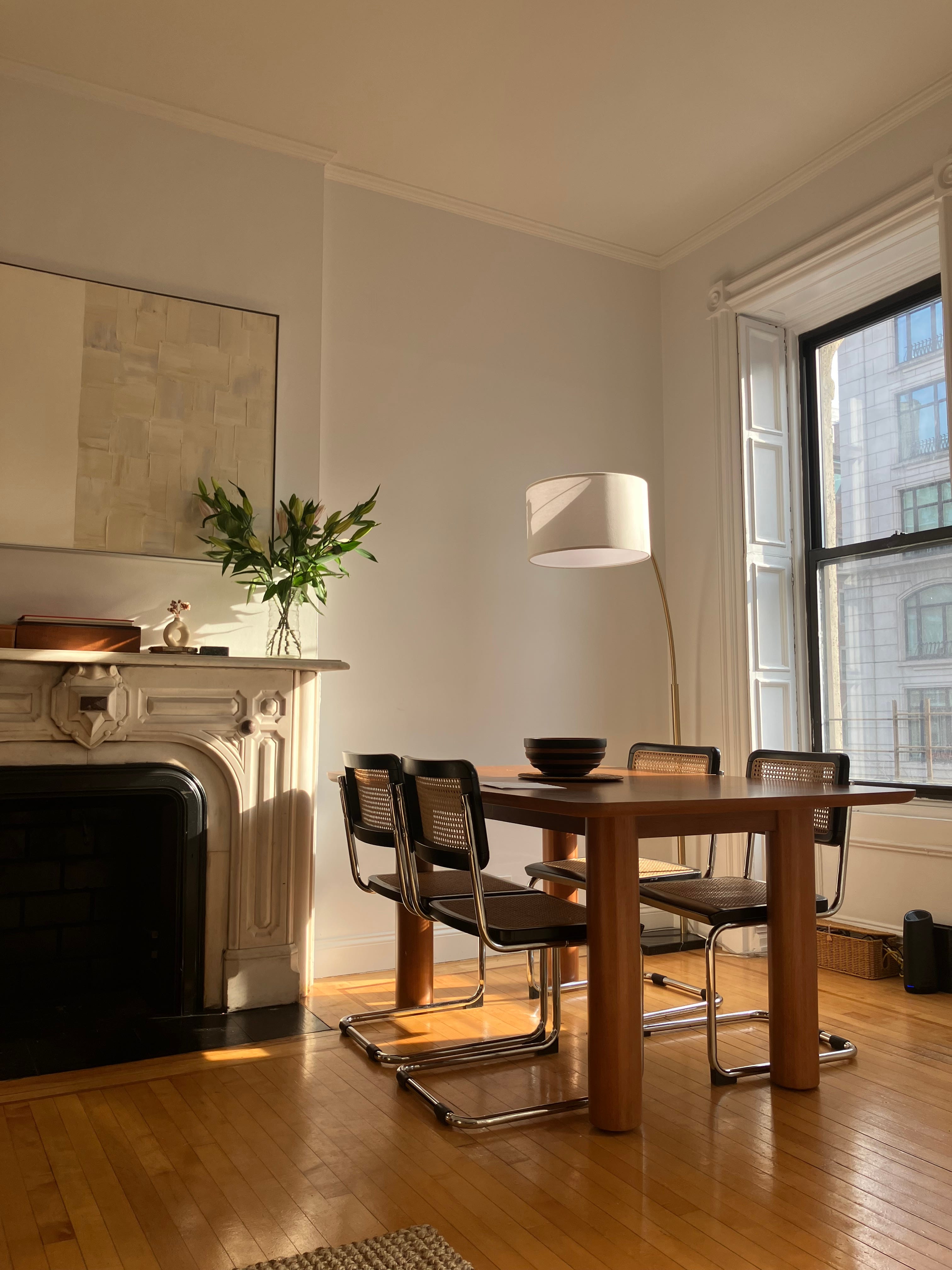
I wanted to start hosting dinner parties at my apartment. At that time I lived in a charming but very tiny apartment in Chelsea I called a “flexed studio”. My living room/dining room was 9ft x 12ft.
The class took place in a beautiful apartment in Fort Greene. The first session, there were magazines laid out in the middle of the living room. The instructors, Samantha Andrews and Jocelyn Orante, walked us through some of the basics of design and the history of different styles, both modern and older. When they showed mid century modern, I knew immediately. That’s it. A moment of recognition of what I loved and the language around it.
For homework, they encouraged us to take some time to think about what specific elements resonated for each of our styles, and that that would allow us to then create our own personal style. I left inspired and starting playing around with Claude, inputting images I liked, understanding some of the basic characteristics of my own design taste. I came back to the next class having created not just a name for my style, “Mid Century Modern Atrium”, but also an entire slide deck (once a consultant always a consultant) explaining the style, it’s syntax, and the before and after of my space.
The second class was about layout, in which they taught us some basics of feng shui. The idea is that form follows function, and that once you identify how you want each part of your house to be used, you can create a layout that enables those behaviors/ feelings to occur. One key thing that I identified in my own setup was that the coffee table was impeding the flow of people from the kitchen to the dining table, and that the having to skirt around it made it very hard to feel relaxed in the space.
It was one of the most incredible classes I’ve taken because it gave me the language to express what I like and how I want to live. When I moved to a bigger apartment a few months later, it wasn’t just more space. I knew exactly what I wanted it to feel like, and why.
Join!
I have many more lessons from classes I’ve taken, and even more from my own two years of teaching reading groups through Fractal.
These classes were the opposite of the consulting cave: spaces where I actually felt something, got excited, transformed. They fundamentally changed the way that I move around the world, how I inhabit my body, my home, and spaces online. I take myself less seriously online now. I talk to strangers. I know what my living room is for.
If you’re intrigued, Fractal classes for Spring 2026 are open!!!! I highly recommend joining this wonderful community. Check out the full spring offerings here. Applications are due 3/25.
Find me on Substack, follow along on Instagram, or learn more about our reading groups at closereadingnyc.com.
omg look at that gorgeous interior. you’re a natural designer!! 🫶